
 EN



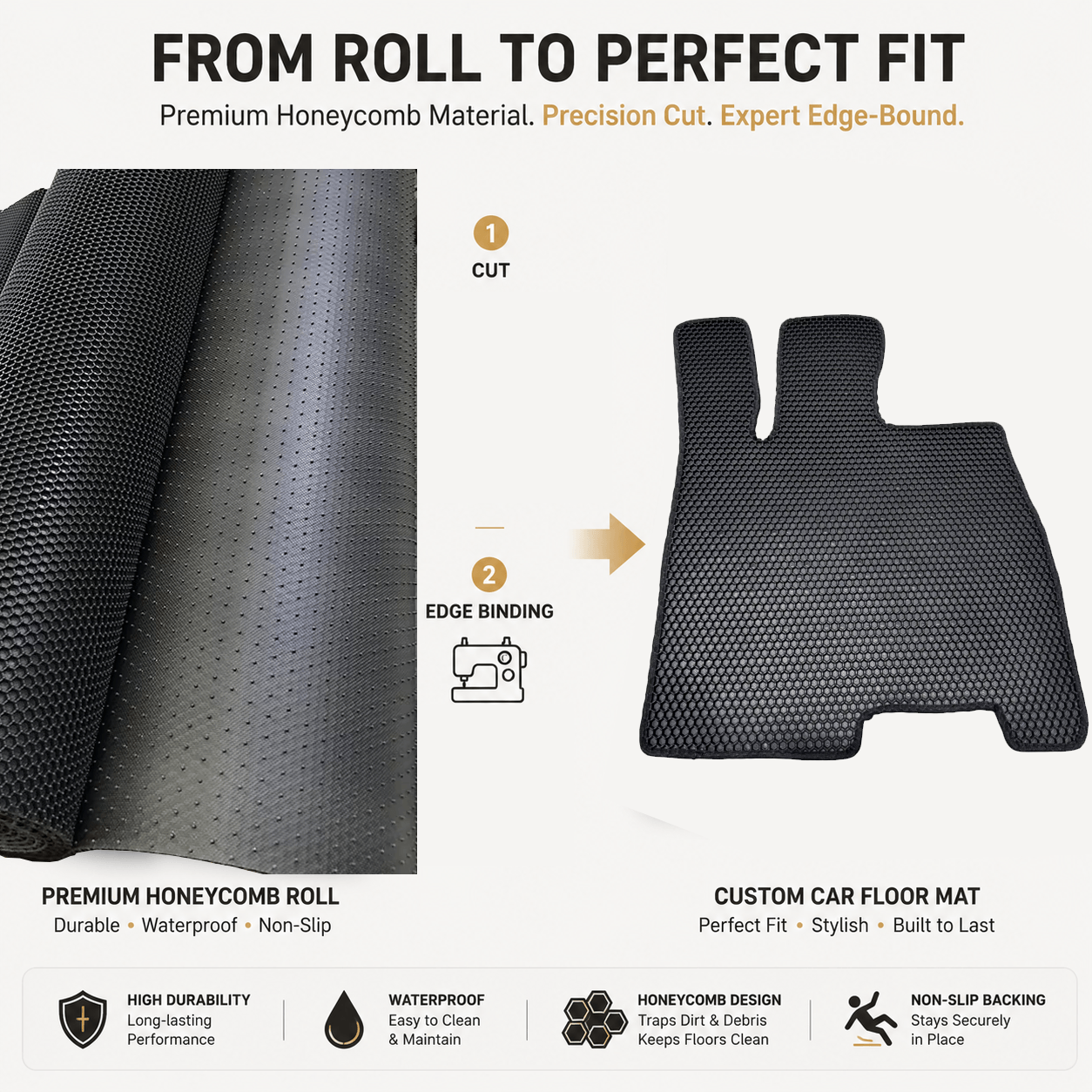
Car mat roll material is the raw roll goods a mat manufacturer cuts into finished floor mats — most often PVC, TPE or EVA foam — and a roll order is settled by four specifications, not by brand names: polymer type, material thickness, surface texture, and roll or sheet format. If you are the buyer, the practical question is not "which car mat material is best" but "which thickness and texture fit the mat I am going to cut, at a roll width my cutting table and my finished log can handle."
This guide walks through those four decisions in the order they affect cost and fit, using the roll formats and thicknesses actually listed on this site as reference points, so you can compare your own specification against something concrete.
What "car mat roll material" actually covers
It covers flexible sheet sold by the roll for conversion into mats, and it is a different product from a finished car mat. A roll buyer controls thickness, surface pattern, colour, backing and roll length, then cuts and finishes the mat in-house; a finished-mat buyer controls fit, edge finish and packaging but inherits the material decisions from the factory.
That difference matters when you compare suppliers. A page selling rolls should tell you the thickness, the roll dimensions, the surface pattern and what the material is normally converted into. A page selling finished mats rarely does, because those numbers are the factory's internal choice. If you are sourcing material for your own production, ask for the roll specification sheet first and the sample second — not the other way round.
The four specifications that decide the order
Polymer, thickness, texture and roll format are the four variables a supplier can actually adjust, and each one moves a different cost: polymer moves unit price and feel, thickness moves weight per square metre and stiffness, texture moves grip and cleaning behaviour, and roll format moves cutting loss and freight.
| SKU | Material | Thickness | Roll / sheet format | Surface | Typically converted into |
|---|---|---|---|---|---|
| AT5012 | PVC | 6.5 mm | 1.2 × 9 m roll | Anti-slip texture | 2D-drawing cut floor mats |
| AT5021 | PVC | 7 mm | 1.2 × 9 m roll | Raised repeat pattern | Front, rear and trunk mats |
| AT5023 | PVC | 7 mm | 1.2 × 9 m roll | Honeycomb | Mat sets with one pattern across panels |
| AT5029 | PVC | 6 mm | 1.2 × 9 m roll | Hexagonal | Full set: driver, passenger, rear |
| AT5006 | PVC | 6 mm | Roll | Chain texture | Driver, passenger, rear mats |
| AT5022 | PVC | 3 mm | Roll | Smooth, wide format | Trunk and cargo liners |
| AT5026 | PVC | 2 mm | Roll | Cube | Trunk liners, garage floors, shelves |
| AT5005 | PVC | 3 mm | 1.2 × 9 m roll | Printable | Private-label and branded mats |
| AT5023T | TPE | 7 mm | Roll | Honeycomb top, spiked backing | Softer-feel front and rear sets |
| Diamond EVA | EVA foam | 10 mm | 1.6 × 2.8 m sheet | Diamond embossed | Cushioned mats and large trunk liners |
Values above come from the current product pages for each roll; confirm them again on the specification sheet you receive, because a supplier can change a surface pattern or roll length between production runs. Formats marked "roll" without dimensions are listed that way on their product pages — ask for the exact length before you calculate yield.
How to choose thickness for your end product
Thickness should be chosen from the finished product backwards, not from the roll catalogue forwards, because the same polymer at 2 mm and 7 mm behaves like two different materials on the cutting table and in the footwell.
| Thickness band | Fits when | Watch out for |
|---|---|---|
| 2–3 mm | Trunk liners, cargo floors, shelf and utility protection where the mat must stay flat and thin | Edges curl more easily; heavy foot traffic will show wear faster than in a 6 mm mat |
| 6–6.5 mm | Daily-driver floor mats that still need to clear pedals and sit inside a standard footwell | Pattern depth adds apparent thickness; measure the finished edge, not the pattern peaks |
| 7 mm | Premium sets and deep-surface patterns sold on look and coverage rather than on price per square metre | Heavier rolls raise freight per square metre; confirm the cutting table can handle the weight |
| 10 mm foam | Comfort-led mats and large trunk liners where cushioning is the selling point | Foam compresses under load; do not size it against a hard-surface mat's thickness |
One practical rule: if the mat will be held by factory floor clips, the clip system sets a maximum usable thickness. Check the clip and the retention post before you commit to 7 mm — a thick mat that lifts the clip out of the carpet is a return, not a premium feature.
What surface texture changes for the buyer
Texture changes three things that show up after the sale: how much grip the mat gives underfoot, how easy it is to clean, and whether the pattern still lines up when the same roll is cut into a driver, passenger and rear piece.
Honeycomb, hexagonal, cube and chain patterns all read as "structured" in photographs, but they differ in cleaning behaviour. Deep, open patterns hold grit and need brushing or rinsing; shallow closed patterns wipe clean but show scuffs sooner. Ask for a sample of the exact pattern at the exact thickness and clean it the way your customer will, rather than judging from a catalogue photo.
Pattern alignment is the specification most often missed. A repeating pattern cut across a full set produces visible mismatch at the front/rear seam if the cutting plan does not keep the pattern in one direction. For single-pattern sets, plan the nesting so all pieces are cut from the same orientation — this is why the same material can look premium in one set and mismatched in another.
Roll format, yield and cut planning
A 1.2 × 9 m roll gives 10.8 m² of material, and that number — not the price per roll — is what you should compare between suppliers.
Worked example, with assumptions stated: take one vehicle set at roughly 1.6 m² of cut area after nesting, one 10.8 m² roll yields about 6 sets (10.8 ÷ 1.6 ≈ 6.75, rounded down to allow for edge trim and pattern alignment). At 2.0 m² per set the same roll yields about 5 sets. The gap between 5 and 6 sets is a 20% swing in material cost per set, which is usually larger than the difference between two suppliers' roll prices.
Two consequences follow. First, ask for the usable width after edge trim, not the nominal width. Second, ask how the supplier packs rolls: a longer roll reduces handling but may exceed what your cutting table can index safely. If your cutting is done on a 1.5 m table, a 1.2 m wide roll leaves 30 cm of unused width per pass — that is a fixed loss you should price in.
For trunk and cargo work, wide formats matter more than thickness. A cargo floor pattern cut from a narrow roll needs a seam where a wide roll does not, and a seam in a trunk liner is the first place water reaches the carpet underneath.
PVC or TPE for roll material
PVC is the default for cut-and-sew mat production because it is dense, dimensionally stable when cut, and available in the widest range of textures; TPE is chosen when the product needs a softer hand feel or a spiked backing for grip.
The difference you can feel is flexibility and surface softness. A 7 mm TPE roll with a honeycomb top and spiked backing behaves differently from a 7 mm PVC roll of the same pattern: it bends more easily and reads softer in the hand, which suits premium and comfort-positioned programmes. PVC holds a crisp pattern and a flat cut edge, which suits high-volume sets where consistency across thousands of pieces matters more than feel.
Neither is universally better. Decide by what your customer will judge in the first thirty seconds: if they touch the mat, TPE feel helps; if they look at pattern consistency and price per square metre, PVC usually wins.
What to put on the specification sheet before ordering
Write these eight items down before you ask for a quotation, and the sample stage stops being a guessing game.
- Polymer and grade — PVC, TPE or EVA, and any recycled-content requirement.
- Thickness with tolerance — nominal plus a measurable band, e.g. 6.5 mm ± 0.3 mm.
- Surface pattern and orientation — pattern name plus the direction each cut piece must follow.
- Roll or sheet format — width, length, and usable width after trim.
- Colour reference — a physical sample or a defined colour standard, not a screen colour.
- Backing — plain, spiked, or laminated, and whether the mat will be held by factory clips.
- Cutting data — 2D drawings or scaled templates, with the nesting plan if pattern alignment matters.
- Approval route — what the golden sample is approved against, and who signs it off.
Item eight is the one that prevents most disputes. A golden sample that is approved for pattern, thickness and colour, and kept by both sides, turns a subjective "this looks different from last time" argument into a measurable check.
Frequently asked questions
Is car mat roll material sold by weight or by roll?
Most suppliers quote by roll or by square metre, and some quote by weight. Compare on square metres of usable material, because weight per roll changes with thickness and pattern depth and cannot be converted into yield without knowing the density.
Can one roll cover a full front and rear set?
Usually yes for passenger cars: 10.8 m² per 1.2 × 9 m roll is several times the cut area of one vehicle set. The constraint is pattern alignment and colour continuity across the set, not total area.
What thickness is too thick for a floor mat?
There is no single number, because the limit comes from the vehicle: pedal clearance, floor clips and the shape of the footwell all set a ceiling. Confirm clearance with the vehicle manufacturer's own information before specifying a thick material for a model you have not produced before.
Next step
If you already know the finished product, send the format you need — polymer, thickness, pattern and roll size — and the sample stage can start from a specific specification instead of a range. Our PVC floor mat roll range and TPE roll range list the current formats; for trunk and cargo work, the trunk mat pages show how the same materials are converted into finished liners. If you need a specification checked against a drawing, send the drawing with your inquiry.
Table of Contents
- What "car mat roll material" actually covers
- The four specifications that decide the order
- How to choose thickness for your end product
- What surface texture changes for the buyer
- Roll format, yield and cut planning
- PVC or TPE for roll material
- What to put on the specification sheet before ordering
- Frequently asked questions
- Next step