
 EN
EN



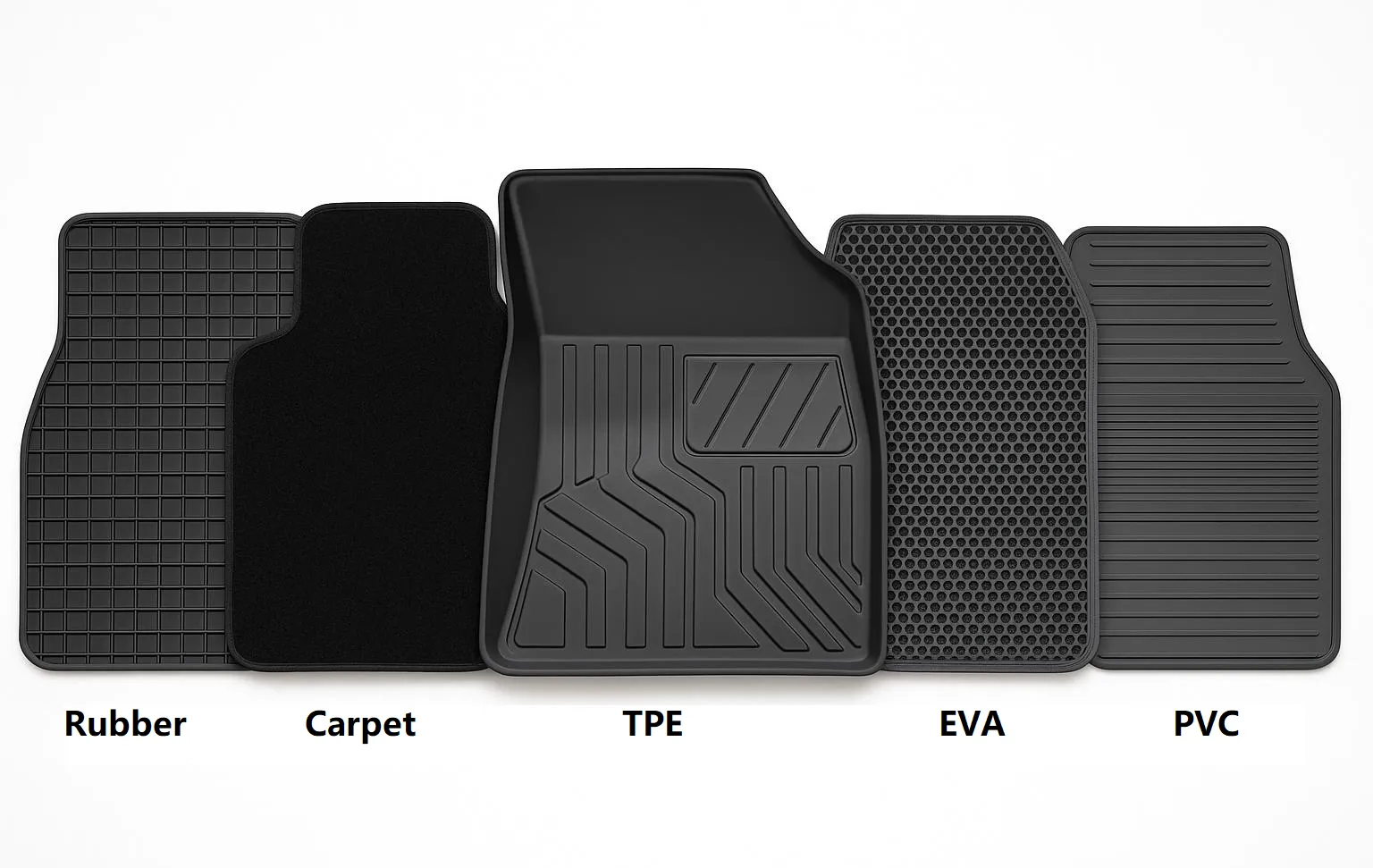
Quick Answer:Car mats are commonly made from materials such as rubber, PVC, TPE, EVA, carpet, and leather. Each material offers different advantages in durability, comfort, cleaning, and customization. Rubber and PVC mats are popular for heavy-duty use, while TPE, EVA, carpet and leather options are chosen based on specific performance and design needs.
What Are Car Mats Made Of? A Simple Guide to 6 Common Materials
Car mats are commonly made from rubber, TPE, PVC, carpet, EVA foam, or leather-look composites. Each material offers a different balance of comfort, water protection, flexibility, appearance, and ease of cleaning.
For example, rubber and TPE are popular for all-weather protection, while carpet mats provide a softer look and feel. PVC is widely used in automotive mat manufacturing because it can be produced in different textures and designs. EVA foam is often chosen for its lightweight and cushioned feel.
However, the material name does not tell you everything about a car mat. Its thickness, surface pattern, backing, shape, and fixing system also affect how well it performs.
In this guide, we'll explain what car mats are made of, compare six common materials, and help you choose the right option for everyday driving or custom car mat production.
What Are the Most Common Car Floor Mat Materials?
Most car floor mats fall into six main material categories.
| Material | Main Characteristics | Common Applications |
| Rubber | Flexible, water-resistant, and easy to wash | All-weather mats, trucks, work vehicles |
| TPE | Rubber-like feel, flexible, and easy to clean | All-weather mats, custom-fit liners |
| PVC (Vinyl) | Waterproof material with Available in many textures and designs | Universal mats, custom mats, mat rolls |
| Carpet | Soft textile surface, available in different colors | Everyday passenger cars |
| EVA Foam | Lightweight, cushioned, and available in different textures | Foam mats, multi-layer mats, custom mat materials |
| Leather-look Composites | Decorative surface combined with supporting materials | Luxury-style and multi-layer car mats |
There is no single best material for every vehicle.
A delivery truck carrying mud and dirt needs different floor protection from a family car used mainly for short city trips. Similarly, a manufacturer purchasing car mat rolls may need different material properties from a brand developing molded, vehicle-specific floor liners.
Let's look at how each material works.
1. Rubber Car Mats: Flexible and Practical
Rubber is one of the most familiar materials used in automotive floor mats.
Rubber mats are usually made from natural rubber, synthetic rubber, or a combination of different rubber compounds. Their flexibility and water resistance make them useful in vehicles exposed to mud, rain, and frequent foot traffic.
Many rubber floor mats have raised patterns that help keep dirt on the mat surface.
Advantages of Rubber Car Mats
Water-resistant and generally easy to wash.
Suitable for muddy shoes and everyday dirt.
Flexible and practical for frequent use.
Available in different thicknesses and surface textures.
Things to Consider
Rubber mats can be relatively heavy, depending on their size and construction. Some formulations also have a noticeable smell when new.
Rubber quality varies, so buyers should check flexibility, odor, wear resistance, and performance under the temperatures expected in their target market.
Best for: Work vehicles, trucks, and drivers who need practical, easy-to-clean floor protection.
2. TPE Car Mats: Flexible All-Weather Protection
TPE stands for thermoplastic elastomer. It is a family of materials that combines rubber-like flexibility with thermoplastic processing characteristics.
TPE is commonly used in modern all-weather car floor mats, including molded liners designed for specific vehicle models.
A well-designed TPE floor liner can offer flexible construction, a washable surface, and raised edges that help contain water and dirt.
Advantages of TPE Car Mats
Flexible, rubber-like feel.
Water-resistant material that is easy to wipe or wash.
Can be molded into vehicle-specific floor mats.
Non-toxic & odorless, no harmful VOCs, eco-friendly material.
Things to Consider
Not every TPE material has the same quality or performance.
Flexibility, odor, wear resistance, and temperature behavior depend on the specific formulation and manufacturing process.
For manufacturers, TPE material selection should also consider the intended forming or converting method.
If you are sourcing materials for automotive mat production, explore ARTES TPE Floor Mat Rolls for available material options.
Best for: All-weather floor liners, vehicle-specific floor mats, and automotive mat projects requiring flexible thermoplastic materials.
3. PVC Car Mats: Versatile and Easy to Customize
PVC stands for polyvinyl chloride. It is also commonly called vinyl.
PVC is widely used in car floor mat manufacturing because it can be produced in different colors, textures, thicknesses, and designs.
Depending on the formulation and production method, PVC can be used for flexible floor mats, textured mat rolls, and parts of multi-layer car mats.
One important advantage is its design flexibility.
For example, a manufacturer can produce PVC mat material roll with ribbed, diamond, or other textured patterns. The material can then be cut and finished into different floor mat shapes.
Two Common Ways PVC Car Mats Are Made
PVC car mats are commonly produced in two ways: molded directly into shape or cut from PVC roll material.
Molded PVC Car Mats
Some PVC car mats are formed directly in a mold.
The PVC material is heated and shaped into the required design, allowing the mat surface, grooves, raised patterns, and overall shape to be formed during the molding process.
This method is suitable for products with a defined shape and is often used for larger production runs.
Typical process:
PVC material → molding → cooling and trimming → finished car mat
Because molds are required, changing to a completely different mat shape may involve additional tooling.
PVC Car Mats Made from Roll Material
Another common method is to first produce PVC as roll material and then cut it into the required floor mat shape.
The surface pattern is usually created during the production of the PVC roll. Afterward, manufacturers can use cutting dies, templates, or CNC cutting equipment to produce different mat shapes.
The cut mats can also be finished with edging, heel pads, logos, or retention clips.
Typical process:
PVC material → PVC roll material → cutting → edge finishing → accessories → finished car mat
This method offers more flexibility for producing different sizes and vehicle patterns because manufacturers can change the cutting template without creating a completely new mold.
For a closer look at converting roll material into finished mats, read our guide: How to Make Car Floor Mats from Car Mat Roll Material.
Advantages of PVC Car Mats
Waterproof material that can be wiped clean.
Available in a wide variety of patterns and colors.
Suitable for different automotive mat designs.
Can be produced as molded mats or supplied in rolls for cutting and further processing.
Roll material can be cut into different shapes and finished with edging, heel pads, logos, or clips.
Offers different material and price options depending on the required specifications.
Things to Consider
Not all PVC floor mats perform the same way.
The formulation, thickness, surface design, backing, and production method can affect how the finished mat feels and performs.
Buyers should pay attention to odor, flexibility, temperature resistance, wear performance, and how the mat is made instead of choosing a product based on appearance or price alone.
For manufacturers, wholesalers, and automotive accessory brands, ARTES supplies PVC Floor Mat Rolls for different automotive mat applications.
Best for: Universal car mats, custom-cut mats, textured car mat rolls, molded PVC mats, and OEM projects requiring flexible material and design options.
4. Carpet Car Mats: Soft and Comfortable
Carpet floor mats are commonly made using synthetic fibers such as nylon, polyester, or polypropylene.
The fibers form the visible surface of the mat, while a separate backing helps support the material and maintain its shape.
Carpet mats are commonly found in passenger vehicles because they match the soft appearance of the original interior.
Advantages of Carpet Car Mats
Soft and comfortable underfoot.
Available in different colors and pile textures.
Can match the vehicle's original interior carpet.
Helps trap dust and dry dirt within the fibers.
Things to Consider
Unlike non-porous rubber, TPE, or PVC surfaces, carpet fibers can hold moisture and stains.
Carpet mats usually require vacuuming and occasional deeper cleaning. If they become wet, they should be dried properly.
The quality of the backing and edge finishing is also important for maintaining the mat's shape.
Best for: Passenger cars, dry-weather driving, and drivers who prefer a traditional interior appearance.
5. EVA Foam Car Mats: Lightweight and Cushioned
EVA stands for ethylene-vinyl acetate.
It is commonly used as a foam material in automotive products because it can provide cushioning while remaining relatively lightweight.
EVA foam can be manufactured in different densities, thicknesses, colors, and surface textures.
Depending on the design, it may be used as the main material of a foam mat or as a cushioning layer in a multi-layer construction.
Advantages of EVA Foam Car Mats
Lightweight and cushioned, offering soft foot feel and shock absorption.
Closed-cell structure, waterproof and stain-resistant; does not soak up water or mud.
Easy to clean: simply rinse, shake off dirt and dry quickly.
Flexible in moderate temperatures, not easy to crack in cold weather.
Can be cut into custom vehicle shapes.
Available in different densities and thicknesses for various cost options.
Things to Consider
EVA may soften and leave permanent indentations under high temperature and heavy long-term pressure. Low-grade EVA can gradually collapse after repeated stepping.
UV exposure over time may cause discoloration, yellowing or surface degradation.
The surface is less scratch-resistant than rubber or PVC; sharp objects may cause cuts.
Low-quality EVA may carry strong odors, and buyers should check formulation and volatile content.
Pay attention to non-slip backing and vehicle fitment. Poorly fitted mats can shift and create safety risks.
Best for: Composite mat backing, family passenger cars, moderate climate regions, buyers looking for lightweight cushion protection.
6. Leather-Look Car Mats: Designed for Appearance and Comfort
Some car mats are sold as leather mats or leather-look floor mats.
However, the visible surface does not always tell you what the entire product is made of.
A leather-look mat may use synthetic leather, PVC-coated fabric, or another decorative surface material. Under that surface, it may contain foam, fabric, or other supporting layers.
The exact construction varies by manufacturer.
Advantages of Leather-Look Car Mats
Decorative appearance suitable for luxury-style interiors.
Different colors, stitching styles, and surface patterns.
Can combine decorative surfaces with cushioning layers.
Suitable for customized interior designs.
Things to Consider
Buyers should confirm the actual surface material instead of relying only on words such as "leather," "premium," or "luxury."
They should also check how the layers are joined, how the edges are finished, and whether the mats can be cleaned easily.
Best for: Drivers who prefer a more luxurious interior look and custom multi-layer floor mat designs.
Are Car Mats Made From One Material or Several Layers?
Not all car mats are made from a single material.
Some rubber, TPE, and PVC mats have a relatively simple construction. Others, especially luxury-style or multi-layer car mats, may combine several materials in one product.
For example, a multi-layer mat may use:
A PVC, PU leather, or carpet surface
An EVA or foam layer for cushioning
A fabric or anti-slip backing underneath
The exact structure depends on the product and manufacturer.
Some mats may have only two main layers, while others use three or more materials for appearance, comfort, support, or backing.
Important: There is no single standard layer structure for all car mats.
When comparing multi-layer mats, it is better to ask what materials are actually used in the finished product rather than judging it only by terms such as “5D,” “6D,” or “7D.”
Does Waterproof Material Mean a Car Mat Is Fully Waterproof?
Many car mats are made from materials that do not readily absorb water, including rubber, TPE, and PVC.
But there is a difference between a waterproof material and a floor mat that can hold water.
Imagine pouring water onto two PVC mats.
The first is a flat mat without raised edges. Although the material itself is waterproof, the water may flow over the sides.
The second has raised edges and a suitable shape. It may hold more liquid on its surface and help prevent it from reaching the vehicle carpet.
Both mats use waterproof material, but they provide different levels of floor protection.
For wet or snowy conditions, consider:
The height and shape of the mat edges.
How well the mat fits the vehicle floor.
Whether the surface has suitable channels or raised patterns.
Whether the mat remains in the correct position.
Material selection is important, but the finished mat design matters just as much.
What Keeps a Car Floor Mat From Sliding?
Many floor mats have raised patterns on the top and textured backing on the bottom.
These features may improve traction, but they do not replace correct installation.
A mat should fit the driver's footwell without interfering with the accelerator, brake, or clutch pedals.
Where the vehicle has factory floor mat retention points, compatible fixing clips or anchors should be used as specified by the vehicle manufacturer.
A mat that moves forward or bunches up can create a driving hazard, regardless of whether it is made from rubber, TPE, PVC, or carpet.
For vehicle-specific manufacturing projects, the mat's shape and clip positions should be confirmed during product development.
ARTES also provides Car Floor Mat Clips for automotive mat production projects.
Safety tip: Follow the vehicle manufacturer's floor mat instructions. Never stack a driver's floor mat on top of another mat, and always check that the pedals move freely after installation.
Which Car Floor Mat Material Should You Choose?
The best material depends on how the vehicle is used, the preferred appearance, and the type of product being manufactured.
Here is a simple starting point.
| What Do You Need? | Good Material Choices | What to Look For |
| For rain, snow, or muddy conditions | Rubber, TPE, PVC | Easy cleaning, raised edges |
| For everyday family use | TPE, PVC, rubber, carpet | Comfort, easy cleaning, stays in place |
| For work or commercial vehicles | Rubber, PVC | Durable surface, good grip, easy cleaning |
| For a classic interior look | Carpet | Soft feel, good backing, easy maintenance |
| For a lightweight, softer feel | EVA foam | Cushioning, shape retention, wear resistance |
| For a luxury interior look | Leather | Surface material, stitching, easy cleaning |
| For making custom-cut car mats | PVC or TPE rolls | Thickness, roll size, easy cutting |
A good material choice should start with the actual application rather than a general claim that one material is better than all others.
What Should You Check When Buying Car Mat Materials?
Choosing the right car floor mat material is not just about whether it is rubber, TPE, PVC, or EVA.
Two mats made from the same type of material can feel and perform differently because of their thickness, surface texture, backing, and overall design.
Before buying car mats or sourcing materials for production, here are a few things worth checking:
Material composition: What is the mat actually made of? Does it contain one material or several layers?
Thickness and flexibility: Will the material suit the intended use and production method?
Surface and backing: Is the mat easy to clean, and does its backing suit the vehicle floor?
Fit and fixing: Does the finished mat fit properly and stay securely in place?
Material quality: Have the relevant wear, odor, and temperature requirements been checked?
Customization options: Are suitable patterns, colors, dimensions, and finishing options available?
For businesses producing car floor mats, selecting the right material is especially important.
At ARTES, we offer automotive floor mat materials including PVC Floor Mat Rolls, TPE Floor Mat Rolls, and EVA Foam Material for different manufacturing needs.
Final Thoughts
So, what are car mats made of?
Car mats are commonly made from rubber, TPE, PVC, carpet, EVA foam, or multi-layer materials. Each offers different benefits, but the best choice depends on your needs, mat design, and overall quality.
Looking for car mat materials or custom solutions?
ARTES supplies car mat roll materials and custom floor mat solutions for manufacturers, wholesalers, and brands. Explore our Car Floor Mat Materials or contact us to discuss your requirements.
Table of Contents
- What Are Car Mats Made Of? A Simple Guide to 6 Common Materials
- What Are the Most Common Car Floor Mat Materials?
- 1. Rubber Car Mats: Flexible and Practical
- 2. TPE Car Mats: Flexible All-Weather Protection
- 3. PVC Car Mats: Versatile and Easy to Customize
- 4. Carpet Car Mats: Soft and Comfortable
- 5. EVA Foam Car Mats: Lightweight and Cushioned
- 6. Leather-Look Car Mats: Designed for Appearance and Comfort
- Are Car Mats Made From One Material or Several Layers?
- Does Waterproof Material Mean a Car Mat Is Fully Waterproof?
- What Keeps a Car Floor Mat From Sliding?
- Which Car Floor Mat Material Should You Choose?
- What Should You Check When Buying Car Mat Materials?
- Final Thoughts