
 EN



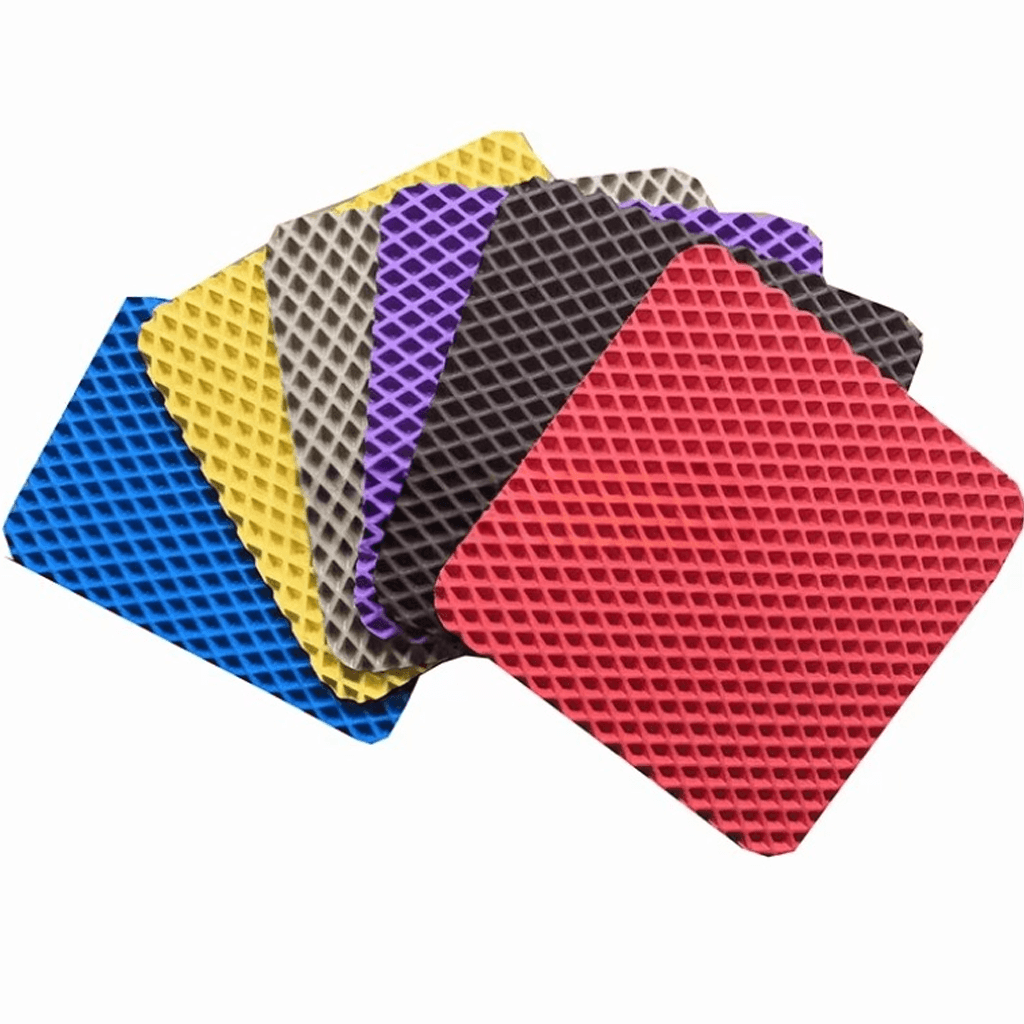
"Non toxic car mats" is a claim about emissions and formulation, not a material category, and a mat can only be judged against it if you know which test was run, on which sample, and at what temperature. Two mats made from the same polymer can differ on odour and emissions because of plasticiser choice, backing adhesive and how long the material was cured — so the useful question is not "is TPE non-toxic" but "what evidence supports this specific mat".
This page sets out what the claim covers in practice, how the common materials differ, and what to ask a supplier so that the answer is verifiable rather than reassuring.
What the claim actually covers
In the automotive interior context, "non toxic" usually bundles three separate things: low volatile organic compound (VOC) emission, absence of a restricted substance list, and absence of noticeable odour. They are tested differently and they fail independently.
VOC emission is measured on a sample heated in a sealed chamber, with the result reported as a concentration against a stated method and temperature — the number means nothing without those conditions. Restricted substances are checked against a list, such as the REACH candidate list of substances of very high concern (SVHC) or a customer-specific list, and the result is a declaration rather than a performance figure. Odour is judged by a panel or by a defined odour test, and it is the least standardised of the three.
A supplier who answers "our mats are non-toxic" without naming which of the three they tested has not answered the question.
How the common materials sit against the claim
Material choice moves the starting point, but formulation and process usually move it further. The table below describes the general position, not a guarantee for any particular product.
| Material | Where it starts from | What usually changes the outcome | Ask for |
|---|---|---|---|
| PVC | Requires plasticiser and heat stabiliser; emission profile depends heavily on which ones | Plasticiser type, stabiliser system, curing time before packing | Which plasticiser, plus a VOC report with method and conditions |
| TPE | Typically formulated without chlorine or phthalate plasticisers, depending on grade | Grade selection, filler content, bonding adhesive if laminated | Grade datasheet plus the same VOC and odour evidence |
| EVA foam | Low-odour by nature, but foam grade and foaming agent matter | Foaming agent residues, lamination adhesive | Odour test result and datasheet for the sheet actually supplied |
Two practical consequences follow. First, the same polymer can pass on one supplier's mat and fail on another's, so a material-level claim never transfers automatically to a product. Second, laminated or multi-layer constructions can undo a good face material: the adhesive and the backing are part of what a person smells.
Why construction matters more than the label
A mat is rarely one material. A typical construction is a face layer, an optional foam layer, an adhesive, and a backing — and each layer contributes to emissions. A low-emission TPE face bonded with an aggressive solvent-based adhesive does not produce a low-emission mat.
This is why "TPE mat" and "non-toxic mat" are different statements. When you specify, specify the construction: face material and grade, backing type, whether adhesive is used and what type, and how long the finished product rests before packing. The last item matters more than buyers expect — mats packed warm and immediately containerised arrive with a stronger smell than the identical mats left to rest.
How that construction choice plays out over years of wear is covered in our guide to sustainable car mats.
Odour: the complaint that actually reaches the customer
Odour is the practical face of this topic. A customer does not measure VOC; they open the box and decide. Two things predict the complaint better than any certificate: whether the mat was packed before it cooled and cured, and whether the carton was sealed for weeks in a container.
For a private-label programme, the useful specification line is a rest period before packing, plus a carton test: seal a sample set in its final packaging for a defined period, then open and judge. That test costs almost nothing and predicts the retail complaint far better than a datasheet.
What to ask a supplier, in order
Five questions separate a real answer from a reassuring one.
- Which claim are you making — VOC emission, restricted substances, or odour? Ask for the one you actually need.
- What was tested, exactly — the finished mat or the raw material? A material-level report does not cover the adhesive or backing.
- Which method and conditions — chamber method, temperature, and duration. A number without these cannot be compared.
- Which grade and which plasticiser — for PVC, this is the single most informative answer you will get.
- What changes between batches — ask how the supplier controls grade substitution when a polymer is short. Most emissions incidents are substitutions, not formulation failures.
If the answers stop at question three, the claim is marketing. That is not automatically a reason to walk away — it is a reason to write the requirement into the purchase order so there is something to test against.
What this means for buyers of roll material
If you buy rolls and convert them yourself, you carry the rest of the chain: your adhesive, your backing, your packing. The material specification is the starting point, and the rest period and packing process you use will decide the odour your customer experiences. Ask for the roll datasheet and the emission evidence for the material, then treat your own lamination and packing as part of the same claim.
Next step
If you need a specific claim supported, tell us which one — emission, restricted substances, or odour — and at which stage it will be checked. Our TPE roll range and PVC roll range list the current material formats, EVA foam sheet covers the foam option, and the FAQ answers the questions buyers ask most often. Send your requirement to our team and we will confirm what can be documented for the grade you need.