
 EN



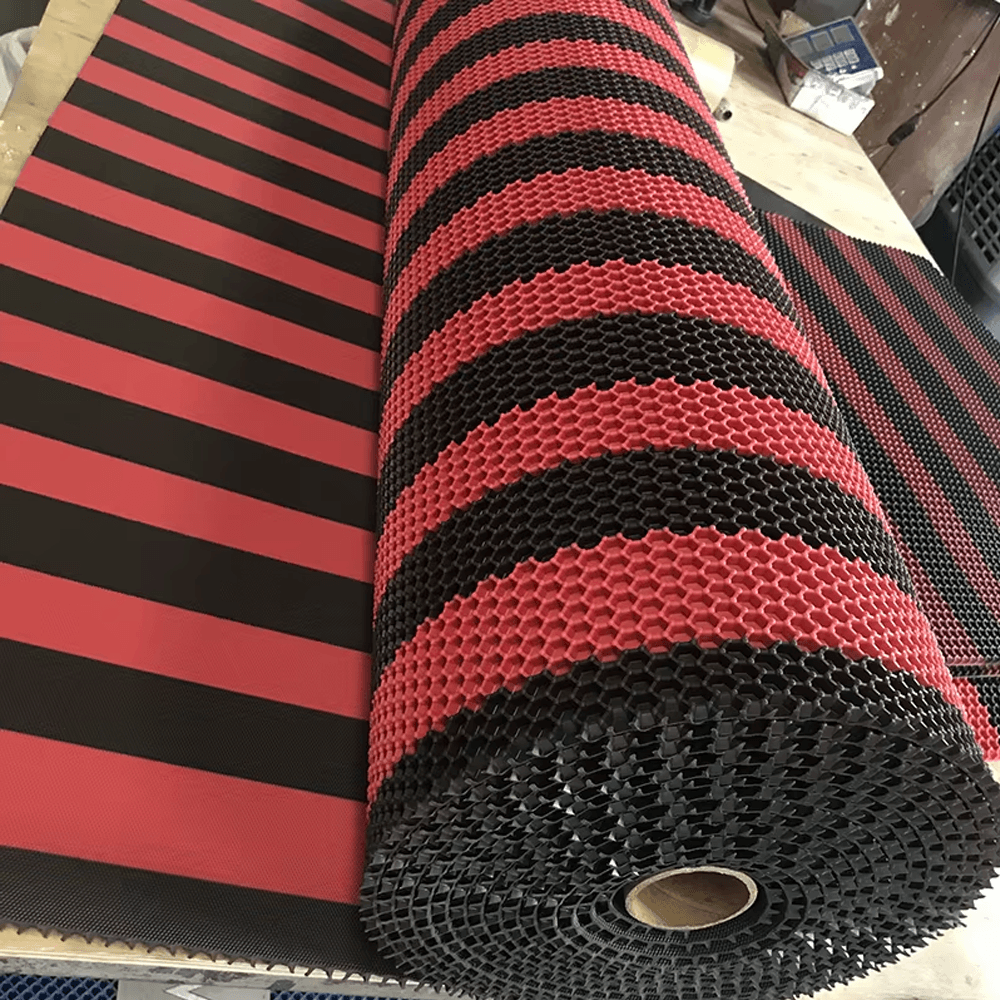
Sustainable car mats come down to three measurable levers — what the mat is made from, how much material is wasted making it, and how long it lasts before it is replaced — and the third lever usually outweighs the first two. A mat that lasts twice as long halves the annual material demand of a vehicle, which is why longevity belongs in the same conversation as recycled content, not in a separate one.
This page is written for buyers who need to make a sustainability claim they can defend, and for brand owners deciding what to put on a specification. It avoids the usual ranking of "eco materials" and concentrates on what can be stated, measured and repeated.
Lever one: material origin
Material origin is the lever buyers ask about first and understand least precisely. "Recycled" can mean post-industrial scrap from the same factory, post-consumer waste, or a chemically recycled feedstock, and each carries a different claim and a different audit trail.
For a mat, the honest positions are narrow. A single-material mat — one polymer throughout — is far easier to recycle than a laminated construction of face, foam, adhesive and backing, because the layers cannot be separated economically. So a mat advertised as recyclable should be checked against a simpler question: can the layers be taken apart, and does any collector actually accept that material stream?
Where recycled content is claimed, ask for the percentage by weight and the standard it was certified against, not a percentage in a marketing line. A claim of "made with recycled material" without a figure tells you nothing about the product, since the figure could be two percent.
For the emission and odour side of the same decision, see non toxic car mats: what the claim should prove.
Lever two: material efficiency
Material efficiency is the lever that a factory controls directly and that buyers can verify from the drawing. It has three components: yield per roll, nesting loss on the cutting layout, and pattern direction constraints.
Yield per roll is arithmetic. A 1.2 × 9 m roll gives 10.8 m² nominal; after edge trim the usable figure is lower, and that difference multiplied across a container of rolls is the first real saving. Nesting loss is the gap between nominal roll area and the area of the pieces actually cut from it — typically where a poor layout quietly consumes five to fifteen percent of material. Pattern direction constraints set the floor on nesting loss: a directional pattern cannot be rotated to fill space, so the layout has to accept more waste.
For a buyer, the practical consequence is that quoting yield without the cutting layout means nothing. Ask for both, or ask how the supplier calculates yield on your drawing.
| Decision | What it saves | What it costs | How to verify |
|---|---|---|---|
| Buying rolls instead of finished mats | Freight volume per square metre; you control nesting | Your own cutting labour and equipment | Compare landed cost per square metre, not per roll |
| Shallower pattern | Material weight per square metre | Perceived premium and grip | Weigh finished samples |
| Single-material construction | Recyclability of offcuts and end-of-life mats | Comfort and acoustic performance of foam layers | Check whether the layers can be separated at all |
| Higher thickness where it is used | Service life in high-wear positions | Material cost and freight weight across the whole set | Warranty terms and field return rates |
Lever three: how long it lasts
Longevity is the largest lever and the hardest to put in a brochure, because it only shows up after two winters. It is also where the arithmetic is most favourable: a mat that survives three winters instead of two removes a third of the material demand, the freight and the packaging from the same vehicle over the same period.
What predicts longevity in a mat is unglamorous. Thickness in the wear path — the heel area, not the whole mat — matters more than thickness overall. Edge construction decides whether the mat curls and gets replaced early. Clip compatibility decides whether it stays in place and wears evenly. None of these are material-origin claims, and all of them are stronger sustainability arguments than a recycled-content figure.
For a brand owner, this suggests a claim that can actually be substantiated: not "our mats are sustainable", but "our mats are specified to last X winters in the driver's footwell, in this thickness, with this edge construction". The second sentence can be tested. The first cannot.
Claims a buyer should refuse to repeat
Three formulations are common and indefensible. "Eco-friendly material" without naming the material or the standard. "100% recyclable" on a laminated mat whose layers are bonded. "Biodegradable" on a polymer mat without a stated environment and timeframe — a mat in a landfill is not biodegrading in any useful sense.
Refusing them is not cynicism. A buyer who repeats an unprovable claim inherits the risk of it, and in several markets the claim itself is regulated independently of whether the product is good.
Where to start if you want a defensible position
Start with the construction drawing, not the material brochure. Decide which layers are necessary, whether the mat can be single-material in the areas that matter, and how much of the roll you will actually use. Then choose the material origin claim, because it is the smallest of the three levers and the easiest to get wrong in public.
If you buy rolls, your leverage sits in nesting and thickness placement. If you buy finished mats, your leverage sits in the specification you write and in how long you expect the set to last.
Next step
If you are building a specification that has to support a sustainability claim, send the construction you have in mind and the claim you want to make, and we will tell you which parts can be documented. Our TPE roll range, PVC roll range and EVA foam sheet show the single-material options, and the OEM service page covers how a construction is developed from a drawing. Reach our team with the claim you need to support.